"Beer in Colorado" is dedicated to that divine elixir born of the marriage of water, malt, hops, and yeast as interpreted
by those living in Colorado. Follow the author as he visits every brewery in the state, creates experimental homebrews,
attends beer festivals, tries interesting beers from around the world, and spreads the good word of beer. Prost!

Friday, February 28, 2014

Two22, The BoB, and Late Posts

The beauty of Beer in Colorado, a personal travel journal as much as it is a beer blog, is Nicole and I can rack up fun experiences, let the memories simmer a few days, and then write a post on it after we’ve had time to digest it all.  As far as you, the reader, know, the time between our little brewery trips and our blog postings about said trips are a narrow window, less than 24 hours, probably.  In actuality, it’s not uncommon for us to sit on a story for a week or so before it goes live. 


It’s not because we’re procrastinators, far from it.  Nicole and I are both quite active, even frenetic, and we hate missing deadlines.  It’s just that life gets in the way.  Sometimes there are more pertinent, time-sensitive articles that need to go out first so we put less significant articles on the backburner (when big events like Great American Beer Festival [GABF] come around, we make absolutely sure our posts are written in a timely manner; our lateness would be pretty obvious if we wrote a GABF article in December).  Sometimes we’re on a road trip, away from our computer, so we have to wait until we’re home before we can begin to compose a post.  Sometimes we just plain forget.  At any rate, we get around to posting our adventures eventually and try to do so in a manner where it appears up-to-date because, frankly, nobody wants to read what appears to be stale news (when I use the word “recently” in a post, for example, that can mean anything from a day ago to a week or two ago). 

However, from time to time, it’s better to admit when an article is behind the times instead of covering up its past-due date.  Great example: the grand opening of Two22 Brew in Centennial, Colorado.  I could pretend like it happened just yesterday but I can’t.  I can’t because “Two22” is so much more than the name of the brewery—it’s also the date of it’s opening: February 22nd or 2/22.

Two22 is likely the most charitable brewery you’ll visit; its name is derived from the fact that $2.22 out of every $10 of profit is donated to the Schuster Family Foundation, an organization that grants funds to various charities ranging in interest from education to environmental issues to youth and personal enrichment programs.  Two22 is beer with a conscience.

Wall of charity at Two22
Nicole and I can relate to the owners of Two22, a married couple who, as former teachers, felt unfulfilled in their occupation so they founded their own brewery instead.  I totally understand how the teaching profession can beat the motivation out of anybody.  Snotty kids.  Irate parents.  Ineffective administration.  Clueless politicians telling you how to do your job.  A public that consistently votes down school funding bonds.  A paycheck that seems a cruel joke.  Oh, yeah; I’ve been there, done that, and felt the hollow void where once my rose-colored naïveté resided.  God bless her, Nicole has a stronger constitution than I and is still in the profession, but she understands the hardships of being a teacher quite well.  While I champion all teachers, I also applaud the owners of Two22 for following their dreams and still making a positive impact on society. 

On opening day, Two22 featured Blonde Ale (4.8% ABV, 51 IBU), Session IPA (4.3% ABV, 94 IBU), Simcoe IPA (6.4 % ABV, 80 IBU), Milk Stout (5.3% ABV, 73 IBU), Centennial Chocolate Porter (4.9% ABV, 43 IBU), and Red Cinnamon.  Nicole and I got a flight of everything except Red Cinnamon because we arrived at noon and that particular beer wasn’t going to be tapped until later (at 2:22 pm, actually).


Left to right: Blonde, Session IPA, Milk Stout, Simcoe IPA, & Centennial Chocolate Porter

The Blonde Ale is a tad hazy in it’s pale, straw yellow body and the aroma is bready, yeasty, and with a twist of lemon zest.  It’s a light, crisp beer with but a touch of bitterness in the back of the mouth.

Despite an IBU rating of 94, Session IPA doesn’t show its hoppiness.  I’d almost call it a malty beer before I called it a hoppy beer because even Nicole, who hates extra hoppy beers, said she actually liked this one.  It, too, is hazy and is a yellowish amber color.

Simcoe IPA looks much like its sessionable brethren but sets itself apart with a nose full of grapefruit and a flavor resplendent with tolerably bitter, citrusy, tropical goodness. 

I found the Milk Stout and the Centennial Chocolate Porter to be quite similar.  They’re both dark beers, of course, with the stout featuring brown highlights and the porter featuring red highlights.  They both feature a great deal of chocolate in the aroma and flavor and they both feature a mild roast (the stout being a bit roastier than the porter).  I felt the porter actually had a creamier Mouthfeel; I almost wonder if I confused the two when I drank myself down the flight. 


In the future, Two22 will use customer feedback to guide their taplist, narrowing the six beers on opening day down to four flagships.  The remaining three taps will be reserved for rotating seasonals.  The tap lines at Two22 are set up for 10 beers so the brewers will be adding even more offerings including experiments with different yeast strains so keep tabs on these brewers; there’s still plenty to come from them. 

After munching on some spectacular arepas from the Freddy’s Cuisine food truck and chatting it up with like-minded beer geeks, Nicole and I started heading home.  But then we decided, since we were in the area, we might as well check out some other breweries we’ve yet to visit.  So, we stopped by The Brew on Broadway (The BoB) for an another drink.


The main marquee at The BoB
Backstage at The BoB

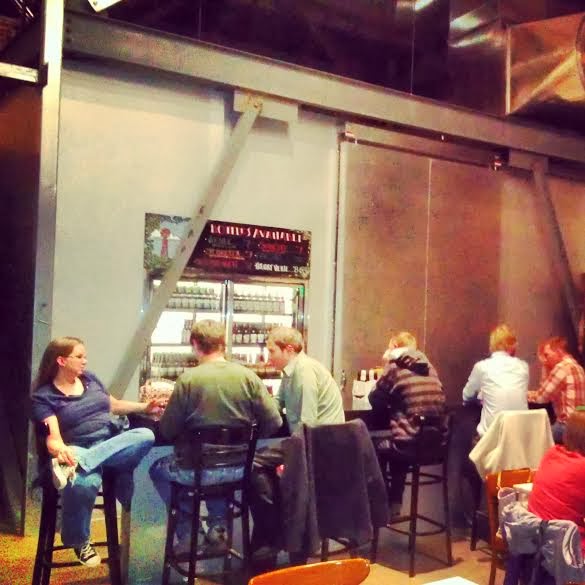
The exterior of The BoB, a brewery/coffee shop, lives up to its Great White Way namesake with a marquee sign (although Nicole and I opted for the backstage entrance in the alley).  The interior of The BoB is wide-open with a dark, wooden bar, exposed brick walls, art hanging everywhere, and a row of garage doors opening up onto a large patio space.  The coffee shop portion is situated at the front of the room as is a sitting space with plush, leather chairs.  In terms of ambiance, I’d say The BoB leans more towards the coffee shop side of its hybrid business concept. 


Cedar Mountain
I ordered a pint of Cedar Mountain Smoked ESB (6% ABV, 71 IBU), a beer that’s mostly clear but with a drop of haze.  It is copper in color and smells woodsy, mildly charred while the flavor’s akin to a long-extinguished campfire with a toasted, untreated-wood bitterness.

When we finished our beers at The BoB, we headed home (for real this time).  Our trip to the southern suburbs got me thinking: to me, everything below Hampden is a brewery black hole.  No, I don’t mean there aren’t breweries there, but I do mean that, with some exceptions (e.g. Dry Dock Brewing Co. because it’s becoming such a major player in the Colorado brewing scene), I hardly ever hear any updates from the southern breweries and, sometimes, I don’t even hear about new ones opening (I didn’t know about St. Patrick’s Brewing Company until a few days ago and Hall Brewing Co. was well on their way before I caught wind of them).  This is odd since I make it my business to know about new breweries in Colorado—anywhere in Colorado—yet, amazingly, I’m more knowledgeable about breweries in Boulder, Ft. Collins, and the mountains than I am about breweries in my own metro area.  I often wonder why.  Do the Denver media sources ignore the southern ‘burbs?  Do the breweries down there keep their advertising campaigns localized, focusing only on their immediate surroundings?  Is it just because I haven’t been paying attention?  I don’t know but, after visiting Two22 and The BoB, I’ll be sure to keep my ear closer to ground, stay abreast of the goings-on in the meridional sections of the Denver area, and make sure I write about Nicole and I’s southerly journeys in timely fashion (“timely” as far as you’re aware, that is).

Prost! 

Chris   


Coffee shop at The BoB
Behind the bar at The BoB
Inside The BoB
Get your brewery passport stamped at The BoB

Sunday, February 23, 2014

The Source, Crooked Stave, and the Craft Beer/Hipster Assumption


Hipsters: with their retro design t-shirts, skinny jeans, and ridiculous facial hair, they infiltrate our urban areas, bleed our ears with vinyl recordings, and deride average folk for their enjoyment of mainstream entertainment (“Yeah, I’m really into Klaus Scheißmusiker, this Austrian xylophonist and Tuvan throat singer.  You’ve probably never heard of him, he only plays on Leap Day in an abandoned subway station under Istanbul.”).  Worst of all, this wacky cultural phenomenon has somehow become associated with craft beer.

How this association came to be is a mystery to me.  As a beer blogger, I’m quite familiar with craft beer culture and, even though Denver isn’t the hipster breeding ground that is Chicago, Brooklyn, or Portland, the Mile High City nonetheless has its fair share of the invasion.  Ergo, I’ve also had many an opportunity to study hipster drinking habits.  The beers I usually see being placed to curlicue-mustachioed lips are Pabst Blue Ribbon, Mickey’s, or something ending in the word “Ice.”  That’s because those beers are ironic; hipsters want suds that are cheap and cool-because-they’re-not-cool i.e. not craft beer. 

So who drinks craft beer, then?  The answer is convoluted, there is no one type of craft beer drinker.  Across the bar at my local brewery, I see the dreadlocked, jeans-patched-with-corduroy hippie sipping on a saison.  I see the dirt-streaked mountain biker and goggle-tanned skier putting down a few porters.  I see young couples, middle-aged couples, and old couples enjoying each other’s company over a flight.  I see sharp-looking business men and women rub shoulders with Carhartt-bedecked blue collar workers.  And, yes, I even see hipsters from time to time.  Craft beer is a libation for all walks of humanity; hipsters make up a small slice of the pie and so does every other type of person until there’s an aggregate whole.  Craft beer belongs to no one faction, it is the people’s drink.

The common space at The Source
Sometimes, even though craft beer in general serves all manner of people, one of those aforementioned factions opens their own brewery, focuses their recipes and décor on their specific culture.  The hippies, for example, have Mountain Sun Pub & Brewery and Shine Restaurant and Gathering Place.  The outdoorsy, sporty people have Jagged Mountain Craft Brewery and Eddyline Brewing.  The traditional suburbanites have Brewery Rickoli and Lone Tree BrewingCompany.  And the hipsters?  They have Crooked Stave Artisan Beer Project’s new location at The Source.

Comida
Comida
Let me amend that statement slightly.  I actually don’t view Crooked Stave as a hipster brewery.  If you had to say something negative about Crooked Stave, you could call it highfalutin, fancy-schmancy.  If you had to say something positive about Crooked Stave, you could call it a daring, innovative brewery, among the most influential in Colorado and possibly the country.  I tend to find myself in the latter camp. 

What's behind the gate? A brewery? Or a velociraptor? 
Nay, Crooked Stave isn’t hipster—The Source itself is hipster.  It’s trendy, it’s got a vintage vibe, it’s hidden in such a way that the hip kids will know about it before the general public, and its urban, artistic aura is thicker than a zebra fart.  And I can’t help loving the place.  It’s so damn cool!  Built in a once-disheveled 1880’s foundry building, this meeting-point for all things artisan is vibrant yet, with brick walls and vaulted, beamed ceilings, retains its gritty, rough-necked past.  The location of the building, likewise, adds to its charm; situated in the River North neighborhood, with pretty much no other retail spots within spitting distance, The Source is a true destination—an oasis in the industrial zone. 

The Source boasts many tenants beyond Crooked Stave: eateries Comida and Acorn, CapRock bar, a butcher, a bakery, a coffee shop, a grocer, a design studio, a flower store, a bank, a cheese and spice shop, and a small bottle shop which, diminutive as it is, features some impressive craft beers.  While CapRock is placed out in the open, in the middle of the building, the rest of the tenants are pushed to the side behind massive, metal gates that seem to have been repurposed from the set of Jurassic Park.

Crooked Stave
Crooked Stave
Crooked Stave
When Nicole and I along with our cohorts Robin, Justin, and Stephen visited The Source a few days ago, we didn’t have the time to see all it had to offer.  We did, however, have some of the best freakin’ tacos at Comida (the grilled bacon and jalapeno taco will melt your face with deliciousness) and, because I view Crooked Stave as one of the top three breweries in the state, we had to pop in there for a drink, too.

"HmmMMM, a buzz I will catch." 

I won’t talk too much on Crooked Stave (because I already have in previous posts) but I will say that the barrel-aged Nightmare on Brett is a pucker-inducing tart beer with the amazing power of salivation inducement.  If you ate 20 saltines and then took one sip of Nightmare on Brett, it’d be like a waterpark just opened up in your mouth; you’ll be slobbering like a St. Bernard in no time.

I still don’t listen to The Decemberists, I wear no oversized, plastic sunglasses, and a courier bag is quite absent from my list of possessions.  No, I am not a hipster; that is a culture I don’t see myself breaking into.  You will, however, see me at The Source.  When out-of-town beer geeks visit Denver, I will point them in The Source’s direction.  When somebody claims that Denver is white bread, boring, I will assume they haven’t been to The Source.  When I feel I need a brett beer or a fantastic taco, I will go to The Source.  It is too badass to ignore.

Prost!

Chris     

Tuesday, February 4, 2014

Lafayette and the Case Against Oversaturation

The outside is inside at Front Range
Brewery oversaturation: it’s a phrase oft heard spilling forth from the maws of craft brewing critics.  Critics who kill our buzz, smugly shake their head with every new brewery opening, and, despite the evidence that craft beer hasn’t even begun to moisten the market, they zealously stand by their assertions.  They’re party-poopers, they’re wet blankets, they’re sticks in the mud, and they’re seemingly blind to all indications that they might just be wrong.  I won’t lecture on the faulty assumptions of these Chicken Littles—“The Brewery Industry is Falling!” alarmists—you can click the above link, peruse the Brewers Association website, or simply do a Google search on the subject and you’ll find plenty of articles arguing  for and against the myth of brewery oversaturation.

Enjoying the "view" at Front Range
Instead, I’d like to relay a bit of anecdotal evidence; a morsel of information that, when pieced together with other fragments of data, creates a collage indicating anything but market oversaturation.  I speak of Lafayette, Colorado, a town with 25,733 people and three breweries within 1.6 miles of one another.  A town with a modest population such as this would surely be considered oversaturated, yes?  Notwithstanding the supposed struggles of operating amid proximate competition, when Nicole and I took a trip to Front Range Brewing Company, The Post Brewing Co., and Odd13 Brewing, all three were packed wall-to-wall, shoulder-to-shoulder with thirsty patrons.  Oversaturation my eye!  Lafayette needs, like, eight more breweries just to keep up with demand!

Mountain Shadow
Our first stop was Front Range, one of the oddest brewery locations I’ve come across.  I’ve been to breweries in churches, I’ve been to breweries in barns, I’ve been to breweries in factories, I’ve been to breweries in baseball stadiums, and, like Front Range, I’ve been to many breweries in strip malls.  Front Range is different, though, in that it’s in a Bio-Dome-esque atrium—the “exterior” doors and windows actually separate the brewery from an enclosed hallway featuring park benches, trees, and skylights giving the illusion of outdoors while actually being safely snuggled under roof and between walls.  It’s a bit funky and, at a glance, one may think—even for a split-second—that they are, indeed, gazing into a small patch of forest.

As suburban a setting as Front Range finds itself, the interior oozes Old World charm with its barrels and wood-paneled tanks on full display imparting a rustic, cozy ambiance.  The bar top, designed with craft beer bottle caps encased in thick layers of lacquer, also exudes character.  It’s a hip little corner on the mall-walker’s route and their Mountain Shadow Black IPA (5.5% ABV), with its black body, mocha foam, and flavors of bittersweet chocolate and hoppy aftertaste, is enough to entice anybody to this wonderfully weird taproom. 

Brew equipment on display at Front Range

Next up: Post Brewing, a member of the Big Red F family of restaurants that caused quite a stir in craft beer circles when they lured Dogfish Head Craft Brewery alumnus Bryan Selders out of his self-imposed beer-making retirement and into their brewing facility.  There’s certainly a great deal of experience that goes behind the beers at Post; it’s not every day a small, Colorado brewery nabs a brewer from one of America’s biggest, most famous breweries.

Like the nearby Gravity Brewing, Post is located in a VFW hall (the difference is that Gravity is in an operating VFW while the Post took over an abandoned hall), hence the name.  The interior designers worked magic, though, and turned a once surely-stuffy space into a chic hunter’s lodge with timber accents, Rosie, a rose-covered elk mounted on the wall, and massive brewing equipment housed in a glass box.  It’s a mix of rural and urban and the end result is sleek yet woodsy.  There’s also an immense beer garden in the back that ought to be great fun in the summertime.    

Rosie at Post
Post bills itself as a fried chicken and beer place and, if it weren’t so doggone busy, I’d have loved to have a sit, gnaw on some wings, and down some suds because, quite honestly, fried chicken and a brewski sounds like my perfect meal.  Seriously, if I were on death row, that’d be my last meal.  Of course, being from the Midwest, I have a natural aversion to fried chicken cooked anywhere outside of America’s breadbasket; I mean, I love the healthy, active lifestyle of Colorado and I love our populace’s general fitness but that usually translates into piss-poor comfort food.  You want good fried chicken?  You got to have grease and salt, dammit!  I’ll ski the calories off later, right now I just want to grub on some fatty poultry!  To be fair, I never got a chance to try Post’s chicken and it may well be among the best fried chicken in the world.  When I come back, I’ll make a point to order a heaping pile of crispy brown goodness and, in the end, I’m sure I’ll enjoy it because, hey, it’s still fried chicken.  I do, however, doubt it could ever hold a candle to Wagner’s Village Inn of Oldenburg, Indiana.    

Tanks at Post
I ordered the Big Rosie Porter (6.8% ABV), named for the hulking head overseeing the taproom but, because I get antsy in large crowds, I tucked myself and Nicole into a corner, drank my beer, but didn’t take the time to jot down tasting notes.  It was good but the Post hadn’t been open for very long so the tap list was lacking; I look forward to visiting again and trying more beers on a quieter night. 

Big Rosie Porter
Lastly, we popped over to Odd13.  Just as congested as the previous two breweries, Nicole and I decided to drink our beers on the back porch.  The icy chill of the night was certainly something with which to contend but it was worth the briskness just to get a little elbow and breathing room.  Thus, we strode by the mini-arcade in the corner, past the original artwork depicting the “superheroes” of Odd13 beer, and walked up to the jam-packed bar and ordered a taster (if we were going to brave the wintry weather, we didn’t want to have to endure it for long).

The beer I ordered was a brown ale brewed with spruce tips.  The name?  Spruce Campbell (7.2% ABV).  Yes, the craft brewing industry is full of pop culture, punny beer names and to prattle on about each and every goofball appellation would require the lifetimes of a thousand beer bloggers; it’s a popular trend these days for brewers to give their creations names that make their customers titter to themselves as they realize the reference.  This style of clever play-on-words names is so commonplace it’s not even clever anymore.

Outside Odd13
Arcade at Odd13
But this beer is named for Bruce Campbell; perhaps the greatest actor of his generation, famous for such notable roles as Ash Williams, Elvis Presley, Bruce Campbell, and “Snooty Usher.”  The man who pioneered the career path of starring in movies ten people watch a thousand times and playing bit parts in movies a thousand people watch ten times.  The man whose mighty chin could crush the combined mentums of Jay Leno and John Travolta as if they were made of peanut brittle and whose sarcastic wit makes him every comic con’s darling.  The man who retweeted my Untappd check-in to his namesake beer; probably the coolest thing that could possibly happen on Twitter.  He’s the man.  And the beer’s pretty good, too (although it's an affront to the greatness of Bruce to have his beer placed in "The Sidekicks" series; it takes a full-blown hero to defeat an army of Deadites, you know).

Spruce Campbell

We exited Odd13 and gasped, taking in our first breathe of air not shared with ten other people.  Oversaturation, eh?  Well, if the market really can’t handle any more breweries, wouldn’t have all these taprooms been empty?  Ghost towns?  Quiet as a librarian in a morgue in a sound-proof booth?  Consider, too, that Gravity Brewing, Crystal Springs Brewing Company, and Industrial Revolution Brewing Company, while not in Lafayette, are in the towns adjacent: Louisville and Erie, respectively.  It would be hard to find a region that, per capita, has the same concentration of breweries as these mid-sized towns wedged between the Denver metro and Boulder and yet they absolutely buzz with activity.  Come talk to me about oversaturation when patrons to these breweries can go the bathroom without rubbing shoulders with every person at the bar; until then, you might want to reconsider your stance.

Prost!

Chris  

Tanks at Front Range

Bar top at Front Range

Bruce Campbell artwork at Odd13

Friday, January 17, 2014

Station 26 Douses the Flames of Beer Craving

What did you want to be when you grew up?  An astronaut?  A truck driver?  A dinosaur wrangler?  Many people aspired to be firefighter.  And why not?  They carry an axe, they drive a rad truck, and there’s a reason many playgrounds include a fireman’s pole on their jungle gyms—they’re fun!  Alas, as time slipped away, dreams of Dalmatians, fiery rescues, and asking motorists to put money in a big, rubber boot faded into the ether.  Next thing you know, you’re crammed in a cubicle with a noose-like necktie and a Machiavellian manager/overlord who’s ready to give you the old heave-ho the minute you miss your quota.  This is your life now.  Somewhere along the line, you traded in a Nomex jacket for a three-piece suit and you traded in firehouse chili for a sad, little bologna-on-white-bread sandwich wrapped in plastic (you write your name on it but somebody still keeps stealing it from the break room fridge!).  The flicker of fluorescents a mocking reminder of the flames you dreamt of dousing.


There’s hope yet.  There’s a chance for you to resurrect your youthful ambition—albeit briefly—and enjoy a nice glass of beer while you’re at it.  I speak of Denver’s newest brewery, Station 26 Brewing Co., built in the remnants of an old firehouse. 


Way out east in the Stapleton neighborhood, Station 26 is situated just off Quebec Street between the tent-shaped Renaissance Denver Hotel and Martin Luther King, Jr. Park.  The exterior remains largely unchanged from its years as an operational firehouse: a wall of garage doors from which fire engines once roared out in pursuit of conflagrations, towers and antennae housing all manner of equipment, and simple, no-nonsense brick walls.  Indeed, if one were to remove the word “Brewing” from the front of the building, the place would look much as it did prior to its suds-slinging days.

Cherrywood-Smoked Golden Ale (the red wall is actually a fire hose)

No heroes will be sliding down this pole

The interior continues the theme although in a more stylized fashion.  For example, the wall on which the taps are attached is, in fact, covered with a deflated red fire hose.  The brass poles countless firefighters have slid down are intact (even if the holes in the ceiling have been filled in) and the under-bar coat hooks are actually industrial-grade pipe faucets.  The communal tables, while not exactly fire-related, look great with their butcher-block tops and the shiny, metal brewing tanks—in full view from the taproom—are an impressive substitute for the laddered vehicles which once idled in the same space. 


While we didn’t have much time to spend, Nicole and I squeezed in a couple of brews including Cherrywood-Smoked Golden Ale, a beer that’s not technically a rauchbier yet still possesses an undeniable smoky quality.  It isn’t the intense, BBQ flavor oft found in rauchbiers.  It’s a subtle smoke, not an asphyxiating one.  Peel off that oxygen mask, you won’t need it with this beer. 


As we took in the ambiance, Nicole and I overheard the bartenders converse about their hopes of drawing in out-of-town cowboys and ranchers from the National Western Stock Show (Nicole and I did pass a lot of horse trailers on our way to Station 26; they’re definitely in the area).  That got me wondering about craft beer’s target audience.  On one hand, I imagine salt-of-the-earth folks drink nothing but the same ‘Merican beer their pappy drank on the old homestead’s front porch, none of that hoity-toity, artsy-fartsy craft beer junk (never minding that many of those craft beers are truly American while most macrobeers are majority owned by foreign interests).  On the other hand, we’re also talking about rodeo riders, here: risk-takers, adventurers, manly-men.  If they got the guts to strap themselves onto a 2,000 pound, horned quadruped with a bad attitude or un-ironically wear a bolo tie in public then what excuse do they have for not trying a different beer from time to time?  I know that Elevation Beer Co., rodeo grounds adjacent, gets a lot of cowboy clientele (of course, they pretty much stick to the 8 Second Kӧlsch, hardly dabbling in the more advanced stuff) so why not Station 26?  Stock Show attendees certainly represent a tough demographic for craft beer to crack but it’s not an impossible endeavor and it’s important to open up new markets so that craft beer can continue to grow.  Now, we just need to wrap about eight rolls of duct tape around Toby Keith’s head so he can never again spout the asinine philosophy that “you sir do not have a pair of testicles / If you prefer drinkin' from glass” thus poisoning the minds of these potential craft customers.


Whether you’re a buckaroo, a wannabe firefighter, or somebody who just plain likes beer, Station 26 is the place to be.  Have a seat, have a beer, and, if you’re lucky, you’ll find the marble in the oatmeal and get to drink from the firehose (don’t ask me to explain, just click the link).

Prost!

Chris

Saturday, January 11, 2014

The Great SandLot Debate: VISIT DENVER's January Travel Writer Reception

Oh, what do you do with a problem like The SandLot?  It presents a philosophical conundrum to the ardent craft beer supporter.  On one hand, it’s well known that this tiny, ten-barrel brewhouse is, in fact, a single tentacle on the Cthulhu that is Coors.  While this miniscule brewing facility nestled into the northeast corner of a baseball stadium accounts for but a fraction of Coors’ overall production and profit it still, nonetheless, serves the master of R'lyeh. 

On the other hand, damn, their beer is exquisite!  Blue Moon Belgian White—the most famous beer to have been created at SandLot—is often derided but, if we’re being honest with ourselves, it’s a fine beer; it’s expertly crafted and holds its ground when compared to other beers of the style.  Furthermore, while that particular witbier may be the best known brew to have originated at Coors Field, it’s certainly not the only.  In fact, the tap list at SandLot is vast, ever-changing, and full of boundary-defying, experimental beers the likes of which are rarely seen outside of Dogfish Head Craft Brewery.  They don’t do boring at SandLot, no sir, and, believe it or not, they have a lot of Great American Beer Festival and World Beer Cup medals to prove their worth. 

One might call SandLot a “crafty” brewery and, while the “craft v. crafty” debate is a fairly new controversy, it’s gotten so much internet play that it seems as though we’ve been talking about it forever.  The conversation may have been discussed to death but, in my opinion, it should never be outright ignored; there’s still a problem with the world when beers owned by mega-corporations can masquerade as mom-and-pop products.  I find it unnerving that the consumer can’t see the word “Coors” on a Blue Moon label.  Nowadays, any beer geek who’s been a part of the craft community for a few months or so knows who owns who; when they want to support a small, local business, they know where to turn.  I do still worry about those who are just getting into the beer lifestyle—people who are well-meaning advocates of small businesses who simply don’t know who’s benefiting from their purchases.  I imagine the number of people deceived into buying macrobeer is, with today’s easy access to information, quite small.  “Small” is not a synonym for “nonexistent,” though; anytime anybody unwittingly buys MillerCoors or Anheuser-Busch when they think they’re supporting an independent business is a problem. 
 
Nice spread in front of the brewing equipment
Take note: I don’t claim macrobrewed beer is bad.  Oftentimes, it is bad (e.g. Bud Light Platinum, Keystone Ice…etc.) but other times it’s really, really good (e.g. pretty much any of AC Golden Brewing Company’s sour beers).  For me, it’s not about flavor but about honesty.  If you intend to buy macrobeer, that’s fine—do what you do.  If you intend to buy craft but were duped into buying otherwise, well, that gets my hackles up.  If you choose to support a small business then it’s devious for a corporation to pull the wool over the consumer’s eyes, trick them into buying their product instead of what the consumer actually wants. 

Now that I’ve aired my thoughts and concerns, I can get to my point; Nicole and I were invited by VISIT DENVER to attend the January Travel Writer Reception, an opportunity for people who write about and promote Denver to eat, drink, and mingle at SandLot.  Of course, Beer in Colorado has a broader focus (all of Colorado, not just Denver) and Nicole and I, obviously, keep our posts centered on beer but, if you think about it, we’re travel bloggers as much as we are beer bloggers.  We don’t just write about beer, we write about visiting breweries, the journey to and from taprooms, the people we meet along the way, and the other non-booze related activities that occur on our trips.  Yes, we are beer evangelists but we’re also Colorado (and Denver) evangelists.

John Legnard speaks to the crowd

The event was also a chance for the Coors Field staff to show off their new “Rooftop Deck Project” which will soon house a CHUBurger and the 5280 Craft Bar (with those two establishments in development and an active brewery already in place, is Coors Field, in fact, the most craft-centric stadium in the MLB?) as well as to showcase their in-house beers and meet head brewer John Legnard. 

Here are a few highlights from the night:

·         Legnard explained some of the more curious aspects of the brewery.  For one, SandLot, while housed in a baseball stadium, is actually in a building older than the stadium itself.  Before the Coors Field era, that part of town was dotted with early-20th-Century brick-and-mortar warehouses (it still is although most of them have been transformed into condos, art studios, and restaurants by this point).  The SandLot sits in one such building.  In keeping with the adage “they don’t build ‘em like they used to,” urban legend claims the warehouse was so well constructed it couldn’t be torn down—the developers were forced to build the stadium around it.  When you’re at the bar, look to the garage doors on the north wall and notice how you’re standing on higher ground—about as high as the back end of a tractor trailer.  You’re standing on the former loading docks. 
Hangin' with Legnard

·         Ownership of SandLot is very much a gray area.  There is a corner of the taproom devoted to brewing operations where all the equipment is situated safely behind floor-to-ceiling glass.  Everything within that glass box is owned and operated by Coors while everything outside is owned and operated by the Colorado Rockies organization.

·         Legnard talked about the many weird and wonderful beers made at SandLot including the beer/wine hybrids Golden Knot and Crimson Crossing (both of which I sampled and enjoyed).  The brewers made sure the recipes for each featured 51% malted barley and 49% grape juice so as to keep the libations technically classified as “beer” and to avoid the high taxation of wine.   
Golden Knot

·         The other beers I tried were Tongue Thai-ed (noticeable lemongrass flavor), Short Straw Farmhouse Red (a touch sour in the finish), Move Back (short for “Move back to Chicago, local Cubs fans, if you think Chicago is so great,” a name with which any Denver sports fan can relate), Pine in the Neck (piney, as you might expect), Valencia Grove Amber (a hint of orange citrus flavor), and Clueless Beer Writer which, I think, is a bit confrontational but, then again, when you’re brewing tasty beer all the while being harangued for your corporate ownership, I can see how the brewers could get a little sensitive. 

·         I tried to press Legnard on how much of the “competition’s” beer would actually be served at the new CHUBurger and 5280 Craft Bar (the name on the building does say “Coors,” after all; I can see how there might be territorial issues).  He claimed to be out of the loop on such insider knowledge.  I guess we’ll have to wait until opening day to find out.

·         The artist’s renditions of the Rooftop look phenomenal!  Aside from great burgers and (hopefully) great beer on tap, this new deck will have the most killer view of the ballpark, the mountains, and the city skyline; it’s going to be a crowded spot on fireworks games.  The renditions did raise a few concerns, though; if you look closely, many of the stock image spectators look like d-bag hipsters or mean girlfriends.  Plus, I think the graphic designer may be from Arizona because the Jumbotron shows a Diamondback player with his hands raised in victory.  This designer better not curse us with his futuristic vision—unsavory clientele and divisional losses could put a damper on even the best views and brews.

Look at this tool in the highwaters
This doofus, too, with the ironic bowtie
Why's she being so pissy?
Why would they show the D-Backs on the big screen?

We thank VISIT DENVER for the invite and we hope to stay on their radars for future events.  I’ll leave you with a call to action: never stop drinking the beer you love.  If you want a Blue Moon, by God, have yourself a Blue Moon!  I do ask, though, that you remain an informed consumer.  Know where your beer comes from, be skeptical of advertisements, and don’t get hoodwinked by savvy marketing.  There’s absolutely nothing wrong—morally or flavorfully—with drinking a Coors product so long as it’s your choice to do so.  I do urge you, however, to never forget the small brewers; support them, too.  There’s room for everybody in the Colorado beer scene.

Prost!


Chris